By Javier Sánchez · Updated October 2026 · for foreigners living in Thailand

How to get a Thai driving licence as a foreigner

Most expats only need to convert their home licence. Some can't, and have to sit the full tests. This guide shows which route is yours, the exact steps, what it costs, and what to expect at the DLT offices in Bangkok, Chiang Mai, Phuket, Pattaya and more.

Do I need a Thai licence?

Tourists can drive with a valid foreign licence plus an International Driving Permit (IDP) (how the IDP works in Thailand). The Thai government lists "visitors with a valid IDP" among those allowed to drive. How long that lasts is not clearly published: guides commonly say about 90 days per entry, and some insurers refuse claims if you only hold an IDP.

Residents are expected to hold a Thai licence. Guides commonly use "living in Thailand 60 days or more on a non-tourist visa" as the line. If you rent a motorbike every day, ride to work or drive your own car, that is you. Police checks are the first place this matters, and the second is an accident claim: see when the insurer won't pay.

Convert or retake: which route is yours?

The DLT treats you either as a conversion (you already hold a valid licence) or as a new applicant (you don't, or yours can't be accepted). The route decides how many tests you sit.

Route A

Convert your licence

You qualify when all of these are true:

  • Your home licence is valid, not expired, and covers the vehicle class you want.
  • It is in English or Thai, or you have a certified translation.
  • You hold a long-stay (non-tourist) visa and can prove your address in Thailand.

You will do: online course or short video, the four physical tests, and (at most offices today) the theory test. The practical test is usually waived.

Route B

Take the full tests

You need this route if any of these apply:

  • You never held a licence in any country.
  • Your licence is expired. Most offices don't convert expired licences.
  • You only have a provisional, learner or probationary licence.
  • You lost the original and can't produce it.
  • You want a motorcycle licence but only hold a car licence (it is a separate class, see the motorcycle licence guide).
  • The office won't accept your licence and you can't fix the reason (translation, class, visa).

You will do: the 5-hour training, the four physical tests, the theory test and the practical test.

The theory test applies to you either way

DLT information reported in January 2025 says foreigners with a valid foreign licence or IDP "can request an exemption from the theory and driving exams". In practice, since 2025 many offices (Bangkok in particular) ask every foreign applicant to sit the 50-question theory test anyway, and a draft national rule would make it universal. Plan to sit it, and practise in English first.

Take a free practice test

What sources report: Is the theory test required when you convert?

  • Can be exempted. Foreigners with a valid foreign licence or IDP can request an exemption from the theory and driving exams. Lead Stories quoting the DLT, Jan 2025
  • Mandatory for all foreign applicants under the 2025 rules. The Thaiger, Nov 2025
  • Mandatory for foreign licence holders; only the practical test may be waived, depending on the office. The Thailand Life, May 2026
  • No written or driving test for a conversion, only the physical tests. Chiang Mai Visa Run, an agency page
  • Not yet formal: a draft rule would make it universal, but it was not in the Royal Gazette as of late 2025. Thailand With Monchai, 2025

The process, step by step

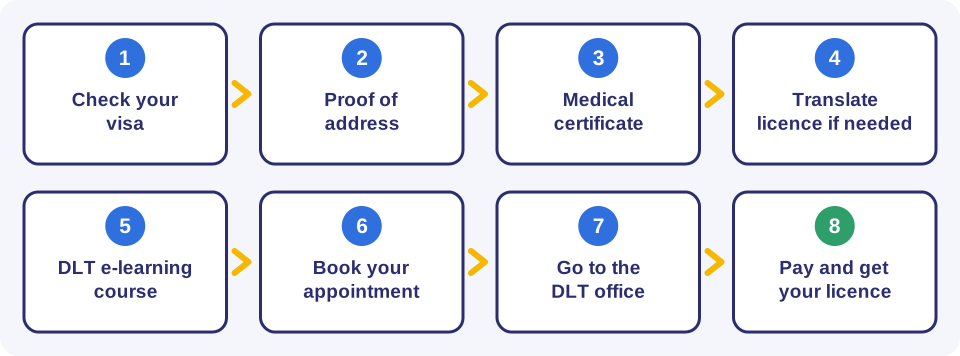
The eight steps to a Thai driving licence: check your visa, proof of address, medical certificate, translation if needed, DLT e-learning course, book the appointment, go to the DLT office, pay and get the licence.
The route from visa to licence. Each step is explained below.
  1. Check your visa

    A non-immigrant visa (B, O, ED, retirement, long-stay…) is the safe bet. Tourist visas are "generally not accepted"; a few offices reportedly take long tourist stays with proof of address, and it can depend on the officer. Some guides list the DTV (Destination Thailand Visa) as accepted. If you are on a tourist visa, call the office before spending money on documents. Full detail: which visa you need.

    What sources report: Is a tourist visa accepted?

    • Generally not accepted, "highly problematic", depends on officer discretion. The Thaiger, Nov 2025
    • Often not accepted at DLT offices; a non-tourist visa is expected. The Thailand Life, May 2026
    • Some branches issue the licence to long tourist stays with address proof; others require a Non-Immigrant visa. Foreigners Thailand, Aug 2026
    • Non-tourist visa required (ED, Non-O, Non-B, DTV and similar). Chiang Mai Visa Run, an agency page
  2. Sort your proof of address

    This is the step that delays most people. The usual document is a Certificate of Residence from Immigration. It is on the DLT's required list for foreign residents. Full details in TM.30 and the Certificate of Residence.

    • Immigration needs a TM.30 on file for your address first, and accepts it as the basis for issuing the certificate. Verified Your landlord or hotel normally files it, and if you rent you can register the address yourself at Immigration with your rental contract and the owner's documents. Verified At the DLT, a work permit or the Certificate of Residence is accepted as proof of residence, and a 90-day report receipt is not. Ask for a copy before you go.
    • Cost is usually 200–500 THB at Immigration, and it is typically valid 30 days
    • Alternatives some offices accept: a letter from your embassy (500–1,500 THB), or a work permit showing your address. Several embassies, reportedly including the US and UK, no longer issue the letter.

    What sources report: Proof of address: what is accepted, how long it lasts, what it costs

    • Work permit with your address: accepted as an alternative. The Thaiger, Nov 2025; Thailand With Monchai, 2025
    • Work permit: not accepted as proof of address. TDL Service, an agency site
    • At the DLT: a work permit and the Certificate of Residence were accepted, a 90-day report receipt was not. Confirmed first-hand by the ThaiDrive team
    • Certificate valid 30 days. The Thaiger, Nov 2025; a Pattaya reader on The Thailand Life, May 2026
    • No expiry date in Buriram. a reader's comment on The Thailand Life, May 2026
    • Immigration fee 200–500 THB, depending on the office. one guide
    • Immigration fee 500 THB, and free at an embassy. another guide
    • Embassy letter 500–1,500 THB, 1 to 3 working days. TDL Service, an agency site
    • At Phuket Immigration: 500 THB if issued on the spot, or free from the next day (a week the last time). Confirmed first-hand by the ThaiDrive team
  3. Get the medical certificate

    From any clinic or hospital in Thailand, on the standard government form (it states you are free of five listed diseases, and checks vision and basic fitness). It is on the DLT's required list.

    • Must be issued within 30 days of your appointment. Get it 1–3 days before.
    • Clinics charge about 100–300 THB. Hospitals can charge 600 THB or more.
    • Details: medical certificate for the licence.

    What sources report: What the medical certificate costs

    • 100–300 THB Foreigners Thailand, Aug 2026
    • 100–500 THB The Thailand Life, May 2026
    • 150–300 THB at a clinic, 600 THB or more at a hospital another guide
  4. Translate your licence if needed

    If your licence is not in English or Thai you need a certified translation, usually certified by your embassy or an authorised translator. Ask which one your office accepts. Detail: translating your licence.

  5. Complete the DLT e-learning course

    An "E-Learning Training Certificate" is on the DLT's required list for converting.

    DLT information reported in January 2025 says non-citizens take a 5-hour course, or only a 1-hour course if exempt because they hold a foreign licence. Some offices let you do it online beforehand, others run a video on site. A DLT-certified private driving school can also give you the course in English with a certificate. Detail: the e-learning course.

  6. Book your appointment

    Most busy offices want you to book through the DLT Smart Queue app or website, and walk-ins may be turned away. Book 1–2 weeks ahead, longer in Bangkok and Pattaya.

    The app reportedly asks for a Thai mobile number to send an OTP code and can fail for foreign passport holders. If it does, phone the office or ask your landlord, employer or an agent to book for you. Detail: how to book.

    What sources report: Do you need an appointment, and how far ahead?

    • Walk-ins are not accepted; book on Smart Queue 1 to 2 weeks ahead. The Thaiger, Nov 2025; Thailand With Monchai, 2025
    • Smaller branches, Koh Samui included, handle walk-ins comfortably most of the year. a guide to Samui
    • Pattaya slots were booked 6 to 8 weeks ahead in February 2026, and needed an agent to book. a reader's comment on The Thailand Life, May 2026
  7. Go to the DLT office

    Allow a full morning. Which office? See offices foreigners use. Bring originals and copies of everything, passport photos and cash. The order is usually: document check, physical tests, theory test, then the practical test if you need it. Dress neatly (shirt with collar, long trousers, closed shoes).

  8. Pay and get your licence

    You receive a 2-year temporary licence. After that you can renew for 5 years. Fees are in the costs table below, and when it expires see how to renew.

    What sources report: How long is the first licence, and when does it become 5 years?

    • 2-year temporary first; renew for 5 years once it is at least one year old. The Thaiger, Nov 2025
    • 2-year probationary first; upgrade to 5 years after 2 years with no violations. Thailand With Monchai, 2025; Wikipedia
    • Car licences "commonly issued for five years" to adults, then 2-year renewals. Foreigners Thailand, Aug 2026
  9. Keep it clean

    Since January 2023 every licence carries 12 points and offences deduct 1 to 4 of them. Each deduction comes back a year after the offence, and reaching zero means a 90-day suspension. The full list of fines, speed limits and points is in driving rules and fines in Thailand.

Documents checklist

Bring originals and a photocopy of each. Offices often ask for more than their website lists.

  • Passport: photo page, current visa and latest entry stamp
  • Certificate of Residence (or embassy letter / work permit, if your office accepts it)
  • Medical certificate, issued within the last 30 days
  • Your foreign licence, original and copy (conversion only)
  • E-learning training certificate
  • Certified translation, if your licence is not in English or Thai
  • International Driving Permit, if your office asks for it next to the home licence
  • Passport photos. The size depends on the source: 2 × 2 inches (Thailand With Monchai), 1.5 × 2 inches or 4 × 6 cm (The Thailand Life lists both), or 1 × 1 inch (other guides). Ask your office, or a photo shop near it will know.
  • Application form, available at the office or on the DLT website
  • Rental contract or TM.30 copy, if your province asks for it

The tests explained

Learning the signs? See every Thai road sign and marking with its meaning.

The physical and practical tests in detail: what each test involves.

1. Physical tests

Four short checks, done at every office in a few minutes:

  • Colour vision: name red, yellow and green.
  • Depth perception: line up two pegs in a box.
  • Peripheral vision: name the colour of lights that flash left and right.
  • Reaction: press the brake pedal when the signal lights up.

2. Theory test

  • 50 multiple-choice questions on a computer, available in English.
  • Pass mark is 45 correct (90%).
  • Covers traffic law, road signs and markings, and safe driving.
  • The English wording is sometimes awkward, so learn the question style beforehand.
  • Format, topics and sample questions.
Practise it free

3. Practical test

New applicants, and conversions at some offices (Bangkok reportedly case by case):

  • Car: drive forward and reverse between poles without touching them, stop parallel to the kerb within about 25 cm, and reverse into an L-shaped bay.
  • Motorcycle: a handling test between cones (balance, slow riding).
  • Several guides say you bring your own vehicle. Ask when you book.

What sources report: The practical test: who takes it and what it contains

  • Waived for conversions. Exempt from the 5-hour training and the practical test. The Thaiger, Nov 2025
  • Can be skipped "in many cases" when converting. Foreigners Thailand, Aug 2026
  • Increasingly rare; some offices, Bangkok in particular, require it case by case. other guides
  • Three manoeuvres: forward and reverse between poles, kerb stop within 25 cm, reverse into an L-shaped bay. The Thaiger, Nov 2025
  • Also parallel parking (within seven gear changes), hill starts and three-point turns, and some DLT material describes five stations. other guides

What it costs

ItemCost (THB)
Car licence, 2-year temporary≈ 205
Car licence, 5-year≈ 505
Motorcycle licence, 2-year temporary≈ 105
Motorcycle licence, 5-year≈ 255
Medical certificate100–300 (hospital 600+)
Certificate of Residence (Immigration)200–500
Embassy residence letter (alternative)500–1,500
Certified translation of your licencedepends on provider
Agent service, all-in1,500–5,000

What sources report: The licence fee itself

  • Car 205 / 505; motorcycle 105 / 255 (2-year / 5-year). The Thaiger, Nov 2025; The Thailand Life, May 2026
  • Motorcycle 105 to 205 for a new 2-year licence. The Thaiger, Nov 2025
  • Fees "vary by class and branch", with no figure given. Foreigners Thailand, Aug 2026

Doing it yourself usually lands between 700 and 1,000 THB all-in, excluding translation. The licence fees above are approximate: they are widely quoted but differ a little between provinces.

Vehicle insurance in Thailand

Every vehicle needs a compulsory policy (Por Ror Bor) and a voluntary one that actually protects you. Claims are most often refused because the rider or driver did not hold the right licence for that vehicle.

Where to go: offices foreigners use

Which office you choose matters more than most people expect. Staff in the big expat provinces are used to foreign passports, but they are also the busiest. Always phone first to confirm walk-ins, the visa they accept and whether they waive the practical test.

  • Bangkok: Chatuchak head office; fills up fast.
  • Chiang Mai: the Mae Hia branch is the usual choice.
  • Phuket: one of the offices most used to foreigners, with first-hand data.
  • Pattaya and Jomtien: scarce slots, many residents use an agent.
  • Hua Hin and Koh Samui: sources disagree on the branch.

All offices, addresses and where sources disagree

Tips and common mistakes

What helps

  • Start with the TM.30. It is the bottleneck for the residence certificate.
  • Time the 30-day documents. The medical certificate and residence certificate both expire, so collect them 1–3 days before your appointment.
  • Go early, or early afternoon. Mornings can have 50+ people queuing; one reader found early afternoon shorter.
  • Ask for the foreigner counter, usually marked and staffed by someone who speaks English.
  • Bring extras: spare photos, extra copies of your passport pages, cash.
  • Practise the theory test in English a week ahead. Don't rely on your driving experience.
  • If one office refuses, ask another. Acceptance can depend on the branch and the officer. Stay polite and don't argue.

What goes wrong

  • Arriving on a tourist visa with no plan B.
  • A residence certificate that never arrives because the TM.30 wasn't filed.
  • A medical certificate older than 30 days by the time you reach the counter.
  • Assuming an IDP exempts you from the theory test.
  • Forgetting the translation of a licence that isn't in English or Thai.
  • Turning up without booking, then being turned away.
  • Wearing shorts or flip-flops. Some offices refuse entry.
  • Paying someone to "arrange" a licence without sitting the tests. It is illegal, and the licence can be revoked.

Do you need an agent?

Not by law. It is worth considering when you can't get a Smart Queue slot (Pattaya), can't receive the OTP code, or your paperwork is messy. Agents typically charge 1,500–5,000 THB. A good one books the appointment, prepares the papers and goes with you, and you still attend and sit the tests yourself. Get the total price in writing first.

When an agent is worth it, and what to get in writing.

Frequently asked questions

Can I drive in Thailand with just my foreign licence?

As a tourist you can drive with your home licence plus an International Driving Permit. The Thai government lists visitors with a valid IDP as allowed to drive. If you live in Thailand you are expected to hold a Thai licence, and insurers may refuse claims if you only have an IDP.

Do I need to take the theory test if I convert my licence?

Officially, holders of a valid foreign licence can request an exemption from the theory and practical tests. In practice many offices now ask all foreign applicants to sit the 50-question theory test, so it is safest to prepare for it. Phone your office to confirm.

Is the Thai theory test available in English?

Yes. The computer test is available in English and Thai. It has 50 multiple-choice questions and you need 45 correct to pass. The English wording can be awkward, so practise beforehand.

Can I convert my licence on a tourist visa?

Most offices say no: a non-immigrant (long-stay) visa and proof of address are expected. A few offices reportedly accept long tourist stays with an address certificate. Phone the office before you spend money on documents.

My licence has expired. Can I still convert it?

Most offices don't convert an expired foreign licence, and a provisional or learner licence is not accepted either. You would then follow the full route: training, physical tests, theory and practical.

I have a car licence. Can I get a motorcycle licence too?

Not automatically. Motorcycles are a separate class, so expect a motorcycle handling test and, depending on the office, the theory test. Bring your home licence if it lists a motorcycle class.

How long is a Thai driving licence valid?

The first licence is a temporary licence valid for 2 years. After that you can renew for 5 years, and some long-term visa holders get the 5-year licence directly. Check the date on your card.

How much does it cost to get a Thai driving licence?

The licence itself is about 205 THB for a 2-year car licence and 105 THB for a motorcycle. With the medical certificate and residence certificate, doing it yourself usually costs 700 to 1,000 THB in total. Agents charge about 1,500 to 5,000 THB.

Is vehicle insurance compulsory in Thailand?

Yes. Compulsory insurance (Por Ror Bor) is required for every registered car and motorcycle, you can't renew the annual tax without it, and driving uninsured can be fined up to 10,000 THB. It covers injuries and death only, so most owners add voluntary insurance for the vehicle.

Will my insurance pay if I ride a scooter on a car licence?

Usually not. A car licence does not cover a motorcycle, and an invalid or wrong-category licence is the most common reason motorbike claims are refused. You need a Thai motorcycle licence, or an IDP that carries the motorcycle category together with your home licence.

What is the difference between Class 1 and Class 3 insurance?

Class 1 covers the other party and your own vehicle, including accidents where nobody else is involved. Class 3 covers only the other party, not your vehicle. The "2+" and "3+" classes sit in between and cover your vehicle only in a collision with another vehicle.

Do I need a Thai mobile number to book the appointment?

The DLT Smart Queue app reportedly sends an OTP code to a Thai number, and can fail for foreign passports. If that happens, phone the office, book through someone with a Thai number, or use an agent.

Ready for the theory test?

470+ questions in English with the official Thai signs and road markings, a mock exam for car or motorcycle, and an explanation for every answer. Free, no sign-up.

Start practising

Sources and disclaimer

ThaiDrive is an independent study tool and is not affiliated with the Department of Land Transport. Requirements, fees and procedures change and differ by office. Confirm everything with your local DLT office before you go. Sign images: Wikimedia Commons (public domain, with one CC BY-SA exception noted in the signs library).