TM.30 and the Certificate of Residence in Thailand
To register a vehicle or convert a driving licence you need to prove where you live. That proof is the Certificate of Residence, and Immigration will not issue it unless your address is on file through a TM.30. Here is how the two fit together, who is responsible for what, and where the sources disagree.

The two documents, in one table
| TM.30 | Certificate of Residence | |
|---|---|---|
| What it is | A notification that a foreigner is staying at an address | A document from Immigration confirming where you live |
| Who files | The owner, landlord, hotel or house master | You, as the applicant |
| Deadline | Within 24 hours of arrival | When you need it, usually valid 30 days |
| Needed for | The 90-day report, visa extensions, and the certificate | A driving licence and a vehicle registration at the DLT |
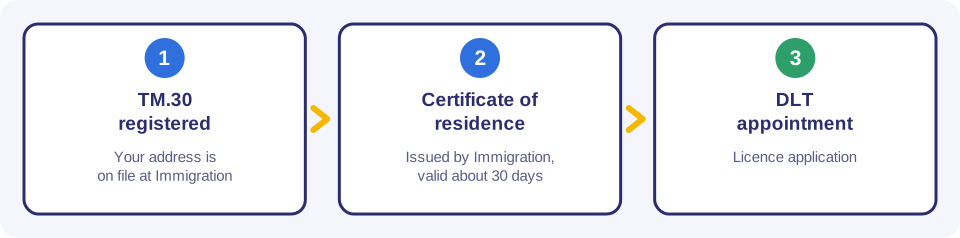
So the order is always the same: TM.30 first, certificate second, DLT third. A missing TM.30 is what blocks the rest.
TM.30: what it is and who files it
Under Section 38 of the Immigration Act of 1979, the owner, head of household, landlord or hotel manager who hosts a foreigner must notify Immigration within 24 hours of the foreigner's arrival. In Bangkok the notice goes to the Immigration Bureau, elsewhere to the local immigration office or, where there is none, the local police station.
- Hotels file at check-in. Managed condominiums usually file through the building management. An owner of their own condo files for themselves. A Thai host files when you stay with them.
- The form has two parts: the owner's details and the address, and the list of foreigners with passport and arrival card number. Names and passport numbers must match the passport exactly.
- Since the 2020 notification the form must also state each foreigner's arrival date and expected departure date.
- You get a receipt. Keep it: it is the evidence you will be asked for at Immigration and at the DLT.
What sources report: Is a new TM.30 needed every time you return from abroad?
- No new form when you return within the stay period on an existing TM.30, since the 2020 notification took effect on 30 June 2020. Tilleke & Gibbins, June 2020
- Yes, a new TM.30 after each return from abroad, even to the same address, and after moving. Thai Visa Services, Sep 2026
- Yes, within 24 hours of arrival each time. Other guides
- No new documents: after each entry you go to Immigration with only your passport and "verify the address", which is already registered. Confirmed first-hand by the ThaiDrive team
Verified In practice the address is registered once with the rental contract and the owner's documents, and after each return you only confirm it at Immigration with your passport. Other offices may handle a return differently, so keep the latest receipt.
How the TM.30 is filed
- In person at the immigration office for the address, or by an authorised person.
- By registered post.
- Online. The owner registers first, which for a first filing can require identifying themselves in person at Immigration.
What sources report: The online portal
- tm30.immigration.go.th, where the landlord registers as the notifier. The owner needs a Thai ID card. Thai Visa Services, Sep 2026
- extranet.immigration.go.th/fn24online/. Another guide
- immigration.go.th, and the Section38 app on Android and iOS, subject to the office's requirements. Tilleke & Gibbins, June 2020
Online filing is not available when the owner has an outstanding fine, and there are commercial "TM30 online" services that are not government sites.
The penalty, and what a missing TM.30 blocks
What sources report: The fine for not filing
- Up to 2,000 THB under Section 77 of the Immigration Act. Thai Visa Services and legal summaries (Section 77)
- 800–2,000 THB per person. One guide
- Up to 10,000 THB for the owner and up to 2,000 THB for the foreigner. Another guide
- No legal penalty for the foreigner, though some offices impose a fine anyway; the 2,000 THB for tenants is unsourced. Thai Visa Services, Sep 2026
The practical cost is bigger than the fine. Without a TM.30 on file, guides report you may be unable to:
- file your 90-day report (TM.47), or have it refused;
- get a visa extension, or have it delayed;
- get the Certificate of Residence that the DLT asks for.
Enforcement differs from one office to another, and some offices barely check.
If your landlord will not file
- Ask politely, and in writing. It is the landlord's legal duty.
- You can register it yourself at the immigration office, with your rental contract and the landlord's documents: their ID, the house registration, and the ownership proof. Verified
- A power of attorney from the landlord works if they cannot attend.
- An agent will do it for a fee (one guide says 500–1,500 THB, with no source).
The Certificate of Residence
This is the document that proves where you live, and the one the DLT lists among the requirements for foreigners. It is issued by the Immigration office for your address, you apply in person, and you normally need:
- Your original passport. Verified Asked for at Phuket Immigration. One guide adds that copies are not accepted.
- Your TM.30 receipt, with the address matching. Verified Immigration accepts the TM.30 as the basis for issuing the certificate.
- The application form from the office. Verified Asked for at Phuket Immigration. It asks what the certificate is for: a driving licence, a vehicle or other. Your visa and entry stamp pages are also reported by guides.
- A passport photo. Verified Asked for at Phuket Immigration. The size and the number of photos depend on the office, so ask.
- The fee in cash, since most offices do not accept cards for this.
Verified At Phuket Immigration they asked for the passport, a photo and a form, with the TM.30 already on file. The other items come from guides and may differ at your office. One guide also reports that the 90-day report status is checked and some offices ask for it.
Can one certificate serve both a licence and a vehicle?
Verified The form asks what the certificate is for, but the certificate we were issued did not state any purpose. That suggests it is the same document for a licence or a vehicle, but we have not requested two, so we cannot confirm it. One agency guide says it can be reused if it was issued within the last 30 days. If you need both, ask the officer before you apply, and use it at the DLT within its validity.
What sources report: What "TM.16" actually is
- A certificate for foreigners granted permanent residence: applied for with form TM.18, fee 191,400 or 95,700 THB, with the house registration, work permit and three 4 × 6 cm photos. Bangkok Immigration, official page
- The address certificate expats use for the DLT, costing about 200–500 THB and valid 30 days. TDL Service and other guides
If an office staff member says "TM.16", ask which one they mean. What you almost certainly need is the address-type certificate, and you do not pay the permanent-residence fee.
What sources report: What the certificate costs
- Free from Immigration; an embassy letter 1,500–2,500 THB, often same day. ThaiLawOnline, Oct 2026
- 500 THB at Immigration, about one working day, reusable if issued within 30 days. TDL Service, Aug 2026
- 200–500 THB, depending on the office. One guide
- 200 THB at Chaeng Wattana in Bangkok. Another guide
- 500–1,500 THB for an embassy letter, 1 to 3 working days. TDL Service
- 500 THB if issued on the spot, or free if you accept to collect it from the next day. Confirmed first-hand by the ThaiDrive team, Phuket
What sources report: How long it takes
- The same visit, at some offices, including Chaeng Wattana on a good day. One guide
- 1 to 3 working days, with a receipt to collect it later. Other guides
- About 7 days at Chaeng Wattana in Bangkok. Another guide
- 1 to 15 working days, with 15 the official maximum. ThaiLawOnline, Oct 2026
- On the spot for 500 THB, or from the next day for free; the last time the free one needed a week. Confirmed first-hand by the ThaiDrive team, Phuket
Verified At Phuket Immigration the certificate is 500 THB if you want it the same day, or free if you can wait: it is ready from the next day, although the last time the free one needed a week. So the "free" and the "500 THB" figures in the sources are both right: they are the slow and the fast option.
What sources report: How long it stays valid
- 30 days. The Thaiger, Nov 2025; a Pattaya reader on The Thailand Life
- No expiry date, in Buriram. A reader's comment on The Thailand Life, 2026
What sources report: Is a work permit accepted instead?
- Yes, a work permit showing your address is accepted at the DLT. The Thaiger, Nov 2025
- No, a work permit is not accepted as proof of address. TDL Service, 2026
- Yes, at the DLT: a work permit was accepted, and so was the Certificate of Residence from Immigration. Confirmed first-hand by the ThaiDrive team
- No, at the DLT: a 90-day report receipt was not accepted as proof of residence. Confirmed first-hand by the ThaiDrive team
Verified At the DLT, the documents that prove where you live are your work permit and the Certificate of Residence issued by Immigration. A 90-day report receipt (TM.47) is not accepted: it confirms you reported your address to Immigration, but it is a different document from the TM.30 registration and from the certificate. The TM.30 is what Immigration needs on file before it will issue the certificate.
The embassy alternative
Some embassies issue a letter or an affidavit of residence that the DLT accepts. It usually costs more and is quick, but it can be unavailable. The Thaiger reports that several embassies, including the US and the UK, have stopped issuing them, so check with yours first.
A sensible plan
Register the address on day one
Take your rental contract and the owner's documents to Immigration, or ask the landlord to file, and keep the receipt. Each time you return, verify the address with your passport.
Book the DLT appointment first
The certificate is only valid 30 days (in most offices), so time it to your slot, not the other way round.
Apply for the certificate a week or so before
The free version can take a week, and it is valid about 30 days. If you are short of time, the same-day option costs 500 THB in Phuket.
Take the originals and a spare copy
Passport, TM.30 receipt, the certificate and your photos.
Then do the DLT step
See the step-by-step guide, or the vehicle purchase and transfer.
The 90-day report (TM.47)
If you stay more than 90 days on the same visa you must report your address every 90 days. The Immigration Bureau says it can be filed online up to 15 days before the due date, that the system emails a "Pending" status and the result within 3 days, and that reminders are sent 15 days ahead. Online filing is not available right after a change of passport, in which case you notify an officer in person or through a representative.
Frequently asked questions
What is a TM.30 in Thailand?
A notification that a foreigner is staying at an address. The owner, landlord, hotel or house master files it with Immigration within 24 hours of the foreigner's arrival, and the foreigner keeps the receipt.
Who has to file the TM.30, me or my landlord?
The legal duty falls on the owner, landlord or host. If the landlord does not, a tenant can file it at the immigration office with the landlord's documents, because without it the 90-day report, visa extensions and the Certificate of Residence can be blocked.
Do I need a new TM.30 every time I come back to Thailand?
Sources disagree. A 2020 notification says a new form is not needed for a return within the stay period, but several guides say a new TM.30 is needed after each return from abroad. Keep the latest receipt and ask your landlord to refile after a trip.
What is a Certificate of Residence in Thailand?
A document issued by Immigration that confirms where you live. The DLT asks for it for a driving licence and for registering a vehicle, and it usually needs your TM.30 on file and is valid 30 days.
How much does the Certificate of Residence cost?
Sources give different figures: free from Immigration, 200 to 500 THB depending on the office, 500 THB, and 500 to 2,500 THB for an embassy letter. Bring cash, as most offices do not take cards.
Practise before the real test
470+ questions in English with the official Thai signs and road markings, and a mock exam for car or motorcycle. Free, no sign-up.
Related guides
 Buying a car or motorbike in Thailand as a foreigner
Can foreigners buy a car or motorbike in Thailand? Documents, new versus used, the ownership transfer step by step with fees, and the checks that avoid scams.
 Road tax, vehicle inspection and LPG checks in Thailand
How to pay road tax in Thailand, when a car or motorbike needs an inspection, how LPG gas systems and tanks are checked, fees and the cost of paying late.
 How to renew a Thai driving licence as a foreigner
Renew your Thai driving licence in 2026: when you can, documents, the reduced tests, fees (505 THB car, 255 THB motorcycle) and what if it has expired.
Sources
- Tilleke & Gibbins: Thailand relaxes TM.30 rules (June 2020 notification)
- Thai Visa Services: TM30 reporting guide (updated Sep 2026, agency site)
- Bangkok Immigration: Application for Residence Certificate (TM.16)
- ThaiLawOnline: buying a car in Thailand, legal and practical guide for expats (Oct 2026)
- Thailand Board of Investment: FAQ on the notification of residence of foreign nationals within 24 hours
- TDL Service: residence certificate in Thailand (2026, agency site)
- The Thaiger: a foreigner's guide to getting a Thai driver's license (Nov 2025)
- The Thailand Life: Thai driving licence guide for foreigners (May 2026)
Requirements, fees and procedures change and differ by office. Confirm with the Department of Land Transport or your local office before you act.